|
|
Classifications, Ranges, Tunings, Vocal Registers
... all on the
Musical
Instruments Poster
Designed by Wayne Chase
|
|
This chart is available in 3 versions:
1.
2.
3. |
Free
PDF download—view
and print it at FULL SIZE (19" wide by 27" high) with your home
computer.
This free version is identical to the paid version (see #2 below),
except that the images in the free version contain transparent
watermarks. Download it HERE
Paid PDF download ($6.95)—view and print it at FULL SIZE (19" wide by 27" high)
with your home computer. This
paid version is identical to the free version (see #1 above),
except that the images in the paid version are NOT watermarked. Download it HERE
Laminated print ($25 + shipping).
Order it HERE.
|
|
See is ALL on YOUR Wall ... A Wealth of Useful Information on
More Than
75 Musical Instruments and Vocal Registers
Useful
● Unique
● Beautiful
● Laminated
This poster comes with a
Free Bonus:
the
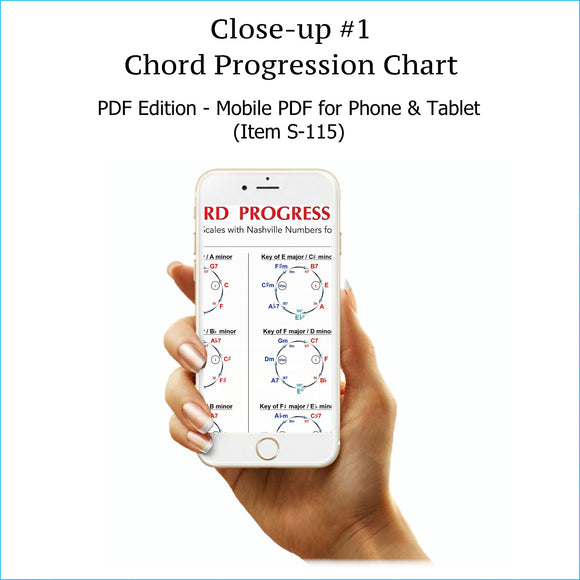
Chord Progression Chart
Scroll Down For Full
Poster
Details

19" Wide x 27" High (49
x 68 cm)
|
|
ALL
ABOUT
THE
MUSICAL
INSTRUMENTS POSTER
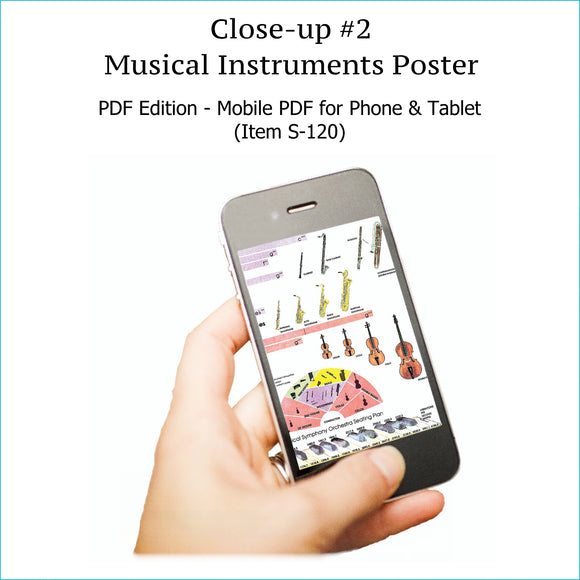
The Musical Instruments Poster
provides information for mixing, arranging, and producing recorded or live
music:
-
Comparative pitch ranges of more
than 70 popular musical instruments (by note and frequency)
-
Six vocal registers (three male,
three female) aligned for comparison with each other, and for reference by
note and frequency: bass, baritone, tenor, contralto, mezzo-soprano,
soprano
-
Tuning directions for 23 of the most
popular stringed instruments
-
88-note Great Staff (Grand Staff),
with each note aligned to its frequency and piano key position
-
Specific pitch frequencies (cycles
per second or Hertz) for all 88 notes
-
Instrument families classified,
sub-classified (e.g. percussion, brass, woodwinds, strings, etc.), and
illustrated to the same scale
~ ~ ~
~
"Once you have a close look at the
clever way it's structured, the Musical Instruments Poster has a lot more practical
information on it than first meets the eye. You have done a superb job of displaying
intelligent and instructive material ... yet the whole effect is entertaining."Bill Tully, Preston, ID
~ ~ ~
~
EQUALIZATION
(EQ)
AND RANGE
GUIDE
FOR SOUND
MIXING,
ARRANGING,
AND SONGWRITING
-
If you arrange, record, or mix music
(home recordings, live music, or studio recordings), you are aware of the
importance of equalization (EQ). To do it accurately, you need to know the
frequencies (number of cycles per second) of the notes associated with the
pitch ranges of each musical instrument and each voice range.
-
Each musical instrument and vocal
register has a different range. The Musical Instruments Poster
displays the frequency (number of vibrations per second, or Hertz) for
each note playable on each instrument, including the various human vocal
registers.
-
Sometimes you may use a multi-octave
electronic instrument such as a synthesizer to replicate the sound of some
other instrument, one you don’t normally play, such as a bass clarinet or
mandolin. That means you need to take care not to play outside the
unfamiliar instrument’s natural range. The Musical Instruments Poster
shows which notes (referenced to an 88-key piano)—and which corresponding
frequencies—define the natural ranges of most popular instruments. So,
even if you have never played the instrument you are emulating with your
electronic keyboard, you can at least make sure you’re playing exclusively
within the emulated instrument’s natural range.
TUNING
DIRECTIONS
FOR 23 POPULAR STRINGED INSTRUMENTS
-
The Musical Instruments Poster
provides tuning information for the orchestral stringed instrument family
(violin, viola, cello, double bass) and for the orchestral harp.
-
As well, the poster shows how to
tune a variety of folk and popular instruments, such as the guitar, sitar,
banjo, pedal steel guitar, and Appalachian dulcimer. The notes
corresponding to the open pitch of each string are displayed on each
instrument’s “range bar.”
-
The Musical Instruments Poster
also identifies special tuning relationships. For example, the violin and
the mandolin are normally tuned identically.
~ ~ ~
~
"You have picked all the right
information to put on these posters ... I find all of them very practical, both for me and
the music classes I teach at night school. Especially the Musical Instruments Poster. Way
to go!"Charles Noga, Scarborough, ON
~ ~ ~
~
RANGES
OF MUSICAL
INSTRUMENTS
AND HUMAN
VOICES
-
The poster shows the pitch ranges
for more than 70 instruments in all (see the full list below). It also
displays the practical ranges of human voices (vocal registers) for bass,
baritone, tenor, contralto, mezzo-soprano, and soprano voices.
-
A horizontal bar shows the range of
each musical instrument and vocal register. The left end of each bar,
representing the lowest note normally playable on a given instrument,
aligns vertically with its corresponding key on the piano. The right end
of each bar, representing the highest note normally playable, aligns with
its corresponding piano key. (For some instruments, some musicians are
able to play higher and lower notes than those displayed on the Musical
Instruments Poster. This also applies to vocal ranges.) Each end of
each range bar displays the name of the note aligned with the respective
piano keys.
-
The 88-key piano keyboard displayed
across the middle of the poster visually aligns with the range bars of all
the instruments and voices. The left and right ends of each instrument’s
range bar align exactly with their corresponding piano keys.
-
Just below the piano keyboard is the
Great Staff (or Grand Staff). It shows the pitches of all 88 piano notes,
aligned directly beneath each corresponding key of the piano keyboard.
This alignment extends to the uppermost and lowermost notes of the ranges
of all musical instruments (and vocal registers) on the poster.
~ ~ ~
~
"[The Musical Instruments Poster] shows
some very valuable insights when you can see all the alignments [of the instrument
ranges].F. Girdler, Moncton, NB
~ ~ ~
~
LIST
OF INSTRUMENTS
AND VOICES
FEATURED
ON THE MUSICAL
INSTRUMENTS
POSTER
The upper half of the Musical
Instruments Poster shows all the instruments of the symphony
orchestra, and their ranges:
ORCHESTRAL INSTRUMENTS
Tuned Percussion
• Xylophone
• Celesta
• Lyra
Glockenspiel
• Orchestral
Glockenspiel
• Tubular
Bells (Chimes)
• Vibraphone
• Marimba
• Timpani
(Kettledrums)
Brass
• Trumpet
• Cornet
• Flugelhorn
• French
Horn
• Tenor
Trombone
• Bass
Trombone
• Euphonium
• Tuba
Woodwinds
• Piccolo
• Flute
• Alto
Flute
• Oboe
• English
Horn (Cor Anglais)
• Clarinet
• Bass
Clarinet
• Bassoon
• Contrabassoon
• Soprano
Saxophone
• Alto
Saxophone
• Tenor
Saxophone
• Baritone
Saxophone
Strings
• Violin
• Viola
• Cello
• Double
Bass
• Harp
• Piano
HUMAN VOICES
Female
• Soprano
• Mezzo-Soprano
• Contralto
(Alto)
Male
• Tenor
• Baritone
• Bass
The lower half of the poster shows a
variety of popular non-orchestral instruments:
NON-ORCHESTRAL INSTRUMENTS
Tuned Percussion
• Jew's
Harp (Jaw Harp)
• Steel
Drums
• Mbira
(Thumb Piano)
Winds
• Pan
Pipes
• Whistling
• Tin
Whistle (Penny Whistle)
• Soprano
(Descant) Recorder
• Alto
(Treble) Recorder
• Tenor
Recorder
• Bass
Recorder
• Organ
• Harmonica
• Concertina
(English Type)
• Piano
Accordion
• Melodeon
(Button Accordion)
• Harmonium
• Melodica
• Uilleann
(Irish) Pipes
• Highland
(Scottish) Pipes
• Northumbrian
(English) Pipes
Strings
• Zither
• Pedal
Steel Guitar
• Appalachian
Dulcimer
• Hammered
Dulcimer
• Autoharp
• Mandolin
• Balalaika
• P’i-p’a
• Sitar
• Lute
• Bouzouki
• Banjo
• Guitar
(Various Types)
• Ukulele
• Electric
Bass
• Harpsichord
• Celtic
(Irish) Harp
• Hurdy
Gurdy (French Type)
~ ~ ~
~
"The members of my choir find the
Musical Instruments Poster most helpful. They have a better understanding of where their
individual voices fit into the sound of the whole choir."Jose Amado, Fresno, CA
~ ~ ~
~
COLOR-CODED
RANGE
BARS
AND SCALED
ILLUSTRATIONS
-
Grey-green bars show tuned percussion instrument ranges
- Yellow bars show brass instrument
ranges
- Purple bars show woodwind
instrument ranges
- Red bars show stringed instrument
ranges
- Blue bars show human vocal ranges
-
Except in a few cases (noted on the
poster), each instrument is illustrated at 1/30 scale on poster size “A”
(regular size). This includes a 1/30-scale silhouette of a person, so you
can compare the size of any instrument relative to the size of a person.
As well, there is a diagram of a typical symphony orchestra seating plan.
FREE
CHORD
PROGRESSION
CHART
INCLUDED!

HOW
TO
GET
THE
MOST
FROM THE
MUSICAL
INSTRUMENTS
POSTER
-
Chapter 3 on how musical instruments work
-
Chapter 4 on scales and intervals
-
Chapter 5 on keys and modes
-
Chapter 9 on vocal ranges
-
Chapter 11 on vocal technique, sound, and style
www.HowMusicReallyWorks.com
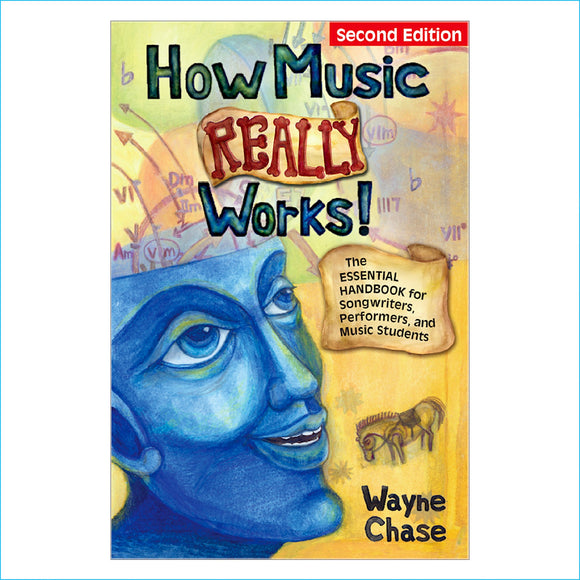
HOW
MUSIC
REALLY
WORKS!
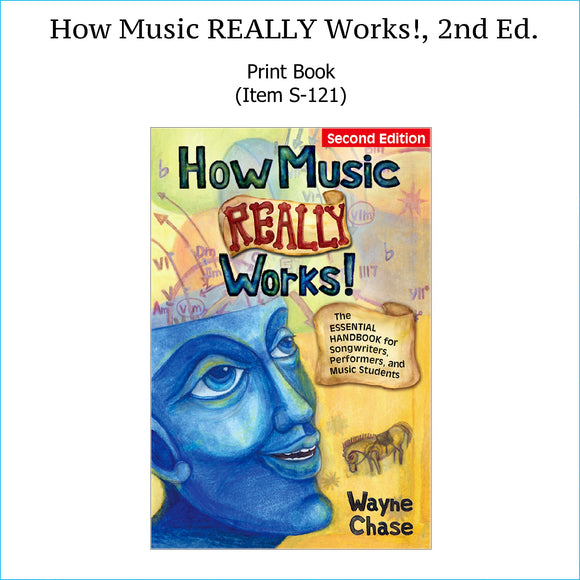
If you don’t yet
have a copy of How Music REALLY Works!, 2nd Edition, you can
read the first 6 full chapters for free at this website:
www.HowMusicReallyWorks.com
For
Performers, Students, and Instructors:
-
Most aspiring
professional musicians and instructors can sing or play an instrument with
considerable proficiency. But they don’t understand much about how music
itself really works.
-
If you want to
get ahead as a musician and/or instructor, then singing or playing an
instrument expertly is not enough.
-
If you aim to
make a living (or at least part of your living) in music as a performer
and/or instructor, you’ll do a lot better if you understand the important
aspects of how music works. For example:
-
What separates a brilliant melody from an ordinary one?
- How do great chord progressions work?
- What makes a lyric emotionally powerful?
- How is it possible to create a unique, original, signature
sound and style?
-
All of these
topics, and a lot more, are extensively and clearly covered in How
Music REALLY Works!, 2nd Edition, the world’s single most useful and
authoritative book for performers, songwriters, and music students.
-
How Music
REALLY Works!, 2nd Edition, is equally useful whether you read music
or play by ear (like most performers and songwriters). You don’t need to
know how to read music. In fact, the book has no music notation—instead,
everything you need to know about creating emotionally powerful music
AND lyrics is spelled out in clear English, with hundreds of
illustrations and examples.
-
If you don’t
already have it, you can purchase How Music REALLY Works!, 2nd Edition,
in print or PDF format, from this order page (phone, online ordering, fax,
or mail):
How Music REALLY Works!, 2nd Ed. Order Page
For Songwriters:
What's the status quo in
original songwriting everywhere?
Lame melodies.
Run-of-the-mill lyrics. Boring chord progressions.
How come?
-
The sad truth is,
99.9% of songwriters fail to rise above mediocrity. Frankly,
they’re simply clueless about effective songwriting technique. They
have no knowledge of the techniques required to write brilliant melodies,
effective chord progressions, and powerful lyrics.
-
If you write
songs as a solo artist or member of a band, you’re one in a pack of
millions. Anybody can write mediocre songs—which is exactly why the
world’s awash in second-rate, forgettable songs.
-
Writing
brilliant songs takes real know-how—which is what you need if you
expect to break away from the pack and get noticed.
-
With How Music
REALLY Works!, 2nd Edition, you can acquire that know-how. You can
quickly start learning effective technique: how to create brilliant
tunes, how to construct brilliant chord progressions, how to write brilliant lyrics.
-
Click on this link
for free access to 470 pages (6 complete chapters):
www.HowMusicReallyWorks.com
|